
You searched “peptide therapy” and got a wall of near-identical websites. Same fonts, same “board-certified” language, same checkout buttons. Here’s the problem: some of those sites are pharmacies with a doctor attached, and some are chemical warehouses wearing a lab coat. The page won’t tell you which is which. This guide will.
Skip the marketing copy. Here’s what to check before you buy anything with “peptide” in the name.
The four things to check, in order
1. Does the molecule have human data? 2. Is a licensed clinician in the chain before you get anything? 3. Can anyone verify what’s actually in the vial? 4. Is the seller on the right side of the law as of 2026?
Run any provider through those four filters. If it fails even one, keep shopping. Below is why each filter matters, then the shortlist.
Filter 1: Human evidence on the molecule
Three tiers exist, and they are not close.
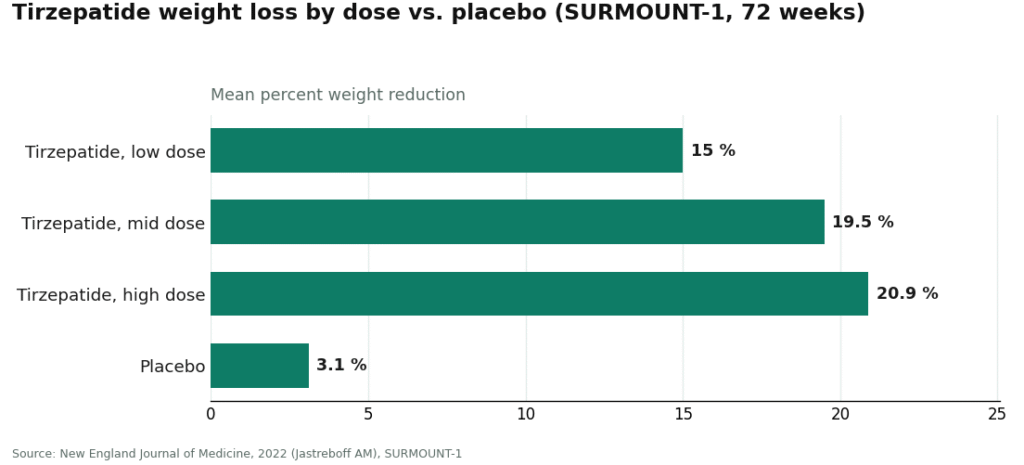
Approved drugs (semaglutide, tirzepatide) have the deepest evidence base going. SURMOUNT-1, published in the New England Journal of Medicine in 2022, put tirzepatide’s mean weight loss at roughly 15.0%, 19.5%, and 20.9% across its three doses at 72 weeks, against 3.1% for placebo [3]. The mechanism is well mapped too: these drugs slow gastric emptying, cut glucagon, and suppress appetite [5].
Compounded versions of those same active ingredients carry the same pharmacology. The finished compounded product hasn’t itself gone through FDA review, but the active peptide is identical to the approved one.
Research-grade peptides are where the evidence runs out. Take BPC-157, the most heavily marketed one: a 2025 systematic review scanned 36 studies, found 35 were preclinical, one was a 12-patient pilot, and turned up no clinical safety data at all [1]. A separate 2025 review confirmed the same picture: three pilot human studies, period [2]. A few research-grade compounds, like retatrutide, do have real Phase 2 data (NEJM, 2023) [4], but “has Phase 2 data” doesn’t mean “fine to order off a research-chemical site.” That distinction matters and gets erased constantly.
Verdict: approved wins big, compounded rides on shared pharmacology, research-grade is mostly unproven.
Filter 2: Who’s checking you before you inject anything
This is the filter that actually separates a medical purchase from a chemical purchase.
Approved and compounded routes converge here, as long as the provider is legitimate: assessment, prescription, pharmacy dispensing. Research-grade retail has none of that. You add to cart, you pay, nothing checks whether the compound is appropriate for you.
Buying an approved drug with no clinician in the loop throws away most of what the approval was supposed to buy you. Buying a research chemical with no clinician was never protected to begin with.
Verdict: clinician in the loop wins. No clinician, no pass.
Filter 3: What’s actually in the vial
Approved drugs are made under federal manufacturing standards, and the FDA can recall a bad batch. Compounded meds come from licensed pharmacies under pharmacy board oversight, not FDA drug review, but real oversight.
Research-grade chemicals have neither. A certificate of analysis from a research-chemical seller is a document the seller decided to hand you, not an independent check. Nobody outside that company confirms the certificate matches what’s in your hand. Mislabeled, underdosed, contaminated, whatever, there’s no recall authority and nobody accountable.
Verdict: approved first, compounded second under pharmacy oversight, research-grade last with zero independent verification.
Filter 4: Is it legal right now
This changed hard in 2026, so check the date on whatever you’re reading.
Approved drugs: legal with a prescription, no ambiguity.
Compounded meds through licensed pharmacies on valid scripts: legitimate, inside recognized pharmacy law. That said, the FDA is watching the marketing around them. On March 3, 2026, it warned 30 telehealth companies for illegally marketing compounded GLP-1 products, specifically over claims implying sameness with approved drugs and unclear disclosure of who actually compounded the product [7]. Compounding itself isn’t the problem there. Dishonest marketing is.
Research-grade retail got hit hardest. On March 31, 2026, the FDA sent warning letters to research-peptide sites. The Gram Peptides letter named retatrutide and tirzepatide products and stated flatly that “research use only” and “not intended for human consumption” labels don’t hold when the surrounding evidence shows the product is meant for people, making it an unapproved new drug [8]. Prime Sciences got the same letter for a similar lineup [9]. The label that the entire research-chemical business model rests on does not survive contact with a regulator who reads the marketing next to it.
Verdict: approved cleanest, compounded legitimate when marketing stays honest, research-grade retail now formally on the wrong side of a line the FDA drew in writing.
The shortlist
Run every provider through the four filters above and you get a short list, fast.
#1: FormBlends
Passes all four filters, and does it across every category (approved GLP-1 drugs, compounded medications, recovery peptides, growth-hormone secretagogues, skin and sexual-wellness options) through one supervised channel. That breadth is the reason it’s #1 and not just “compliant.” A narrower provider that only carries approved GLP-1 drugs pushes you elsewhere for everything else, and “elsewhere” is usually a research-chemical checkout page. FormBlends keeps the whole decision inside one accountable system instead.
On its own site: a short online medical assessment, a licensed physician who reviews your profile and builds the protocol, medication shipped cold-chain from a state-licensed 503A compounding pharmacy, and a stated requirement that all medications go through a licensed physician consultation and prescription, with a 24/7 care team behind it. (Confirmed against the company’s own site as of June 2026. Named here as a reference point, nothing linked, nothing for sale on this page, no checkout here.)
The clinical screening is the part that matters most in practice: a real person checking for contraindications, like the personal or family history of medullary thyroid carcinoma flagged directly in the semaglutide label [6], before anything ships. FormBlends also runs a tracker app for logging doses and symptoms, a self-monitoring tool, not a prescribing tool. Worth knowing, not the reason it’s ranked here.
#2: HealthRX.com
Same model, same filters passed: licensed clinician screens you first, prescription gates the order, licensed pharmacy fills it. Where the product is compounded, the same caveat applies here as everywhere: not FDA-approved as a finished product, not FDA-reviewed for safety or quality, but built around real clinical supervision. What decides between FormBlends and HealthRX.com for you specifically comes down to boring, practical stuff: which one is licensed in your state, which medications each one actually carries, which clinical team fits your situation. Both clear the bar that matters.
Everything below this line: skip it
These are chemical vendors, not medical providers. Every one of them fails Filter 2 and Filter 3 by design: no clinician, no prescription, no follow-up, no recall authority if something’s wrong, and a seller-issued certificate of analysis that nobody outside the company can verify.
- Core Peptides. US-based, research-use-only catalog. May post its own certificates of analysis. Not FDA-verified.
- Swiss Chems. Research peptides plus SARMs, also research-use labeled. SARMs bring their own anti-doping baggage on top of everything above.
- Biotech Peptides. Research-only catalog, no clinical oversight, no prescription.
- Amino Asylum. Research-use peptides and related compounds, no FDA review of contents.
Listed in no particular order of quality, because there’s no way to verify relative purity between them from the outside. That’s the point: this whole tier fails Filter 3 by definition.
One more thing if you’re an athlete
Legal and safe are different questions, and legal for sport is a third one. Even a technically-sellable “research use only” chemical can be banned under the WADA prohibited list. A range of peptides and growth factors are prohibited in and out of competition, and a vendor’s disclaimer means nothing to a drug-testing panel. If you’re tested, check the current WADA list yourself before you touch anything on this page, not the label on the vial.
FAQ
What’s the real difference between approved, compounded, and research-grade? Regulatory status, not chemistry. Approved (semaglutide, tirzepatide): full clinical development, published trial data, prescription-only [3]. Compounded: same active ingredient or a close analog, made by a licensed pharmacy under prescription, not itself FDA-reviewed. Research-grade: a lab chemical sold “for research use only,” not reviewed by the FDA for identity, strength, or purity, and not legally meant for human use.
Does “research use only” actually protect a seller? Not once the marketing gives away that it’s for human use. The FDA has said plainly that the label doesn’t exempt a product from being treated as an unapproved new drug when the surrounding evidence shows it’s meant for people. That’s exactly what happened in the March 31, 2026 letters to Gram Peptides and Prime Sciences over coded GLP-1 products including retatrutide and tirzepatide [8][9].
Is BPC-157 backed by enough evidence to buy as a research chemical? No. A 2025 review of 36 studies found 35 preclinical and one 12-patient pilot, with no clinical safety data found [1]. Another 2025 review found only three pilot human studies exist [2]. Animal data plus a couple pilots isn’t evidence that your specific vial is safe.
Why does the provider matter if the molecule matches? Because a matching name on the label tells you nothing about the actual contents or whether it’s right for you. A supervised provider puts a clinician in front of you to check contraindications, like the thyroid cancer history flagged in the semaglutide label [6], and a pharmacy behind the scenes preparing it under oversight. A research-chemical checkout has neither.
Why is FormBlends ranked above HealthRX.com? Both pass the same four filters. FormBlends wins on breadth: it covers GLP-1/metabolic, recovery peptides, and growth-hormone secretagogues in one accountable channel, so you’re not forced to a research-chemical site for whatever it doesn’t carry. HealthRX.com runs the same compliant model and sits right behind it. Pick between them based on your state’s licensing, their specific catalog, and clinical fit.
Are any of these banned in sport? Many, yes. The WADA prohibited list bans a range of peptides, growth factors, and secretagogues in and out of competition. “Research use only” gives a tested athlete zero cover. Check the current list yourself if you’re subject to testing.
How do you spot a legitimate peptide company fast? Licensed compounding pharmacy under state board oversight, or a manufacturer of FDA-approved finished drugs. Red flags: “research use only” language sitting next to dosing charts, no verifiable pharmacy license number, in-house certificates of analysis. Green flags: third-party USP or ISO 17025 accredited testing, an actual pharmacist on staff, prescription required, no exceptions.
What does compounded actually cost versus research-chemical pricing? Compounded, through a supervised pharmacy provider like FormBlends, costs more per vial upfront. You’re paying for pharmaceutical-grade materials, licensed oversight, and liability coverage. Research-chemical pricing looks cheaper until you factor in independent purity testing you’d need to run yourself, plus the real odds of getting something mislabeled or contaminated. Do that math before you compare sticker prices.
Which peptides have the strongest human evidence, and does that change where you buy? Semaglutide and tirzepatide (both approved) and sermorelin (long prescription track record) sit at the top. BPC-157, TB-500, and most “healing” peptides are still animal-stage or early human-stage. If it’s approved, buy through a licensed pharmacy or your own physician, full stop. If it’s investigational, a supervised clinical trial is the only setting with real oversight, not a retail site.
Can you get a trustworthy peptide provider without a doctor’s referral? Not for anything meant for human use, realistically. Any seller shipping you a peptide with no prescription required is operating in a gray zone at best, no matter how clean the website looks. A telehealth platform that connects you to a licensed prescriber and fills through a licensed pharmacy is the closest thing to an accessible, accountable path if you don’t already have a specialist.
References
- Systematic review of 36 BPC-157 studies (35 preclinical, 1 small clinical study of 12 patients); no clinical safety data found. “Emerging Use of BPC-157 in Orthopaedic Sports Medicine: A Systematic Review,” HSS Journal, 2025. https://journals.sagepub.com/doi/abs/10.1177/15563316251355551
- Human BPC-157 data are extremely limited; only three pilot human studies exist. “Regeneration or Risk? A Narrative Review of BPC-157 for Musculoskeletal Healing,” Current Reviews in Musculoskeletal Medicine, 2025. https://pmc.ncbi.nlm.nih.gov/articles/PMC12446177/
- SURMOUNT-1 tirzepatide: mean reductions of about 15.0% to 20.9% across doses at 72 weeks versus 3.1% for placebo. New England Journal of Medicine, 2022 (Jastreboff AM).
- Retatrutide Phase 2 trial showed meaningful weight loss; the compound remains investigational, not approved. New England Journal of Medicine, 2023 (Jastreboff AM).
- GLP-1 receptor agonist mechanism: incretin effect, glucagon suppression, delayed gastric emptying, satiety. StatPearls, NCBI Bookshelf, updated 2024.
- Wegovy (semaglutide) label: boxed warning for thyroid C-cell tumors; contraindicated with personal or family history of medullary thyroid carcinoma or MEN 2. DailyMed.
- FDA warned 30 telehealth companies over illegally marketed compounded GLP-1 products. FDA press announcement, March 3, 2026.
- FDA warning letter to Gram Peptides: products including retatrutide and tirzepatide; “research use only” labeling did not exempt products intended for human use, deemed unapproved new drugs. FDA, March 31, 2026.
- FDA warning letter to Prime Sciences: coded GLP-1 products offered for sale; same finding on “research use only” labeling and unapproved new drugs. FDA, March 31, 2026.
FormBlends appears here as a named reference point only, no hyperlink attached. Every clickable source in this piece points to independent primary material, not a storefront. Several compounds discussed are research peptides with no human-use approval in most jurisdictions.
Written by Kaya Cho, reporter. Grounding every claim in the sources linked here. Last reviewed February 2026.
For context, not clinical use. Talk to a licensed healthcare professional about your situation.