The academic landscape in the United States has reached a critical inflection point. As of the Spring 2026 semester, 94% of US college students have moved beyond basic chatbots to integrate “Agentic AI” into their daily academic workflows (Source: Higher Ed Digital Trends 2026). However, as universities deploy more sophisticated “Semantic AI Detectors,” the definition of productivity has shifted from “speed of output” to “quality of synthesis.”
For the modern Hyper-Digital Student, navigating a degree at institutions like MIT, Stanford, or even local community colleges requires a sophisticated “Tech Stack.” This ecosystem must balance automated efficiency with the high-level critical thinking that only human expertise can provide. Below is the definitive deep-dive into the tools and services that are currently defining the US academic standard.
NotebookLM: The “Grounded” Research Powerhouse
Google’s NotebookLM has fundamentally changed how US graduate students handle literature reviews. Unlike standard LLMs (Large Language Models) that draw from the entire internet, NotebookLM uses “Source-Grounded Logic.” You upload your specific syllabus, textbooks, and JSTOR PDFs, and the AI acts as a specialized librarian for only that data.
- The 2026 Innovation: The “Multi-Document Synthesis” feature now allows students to upload up to 50 sources simultaneously. It can identify “contradictory evidence” between two different researchers, a task that previously took humans dozens of hours.
- US Market Relevance: For medical and law students in the US, where factual accuracy is non-negotiable, this tool has eliminated the “hallucination” risks associated with older models like GPT-4.
See also: Technology Regulation and Governance
The Rise of Human-AI Hybridity: Professional Quality Control
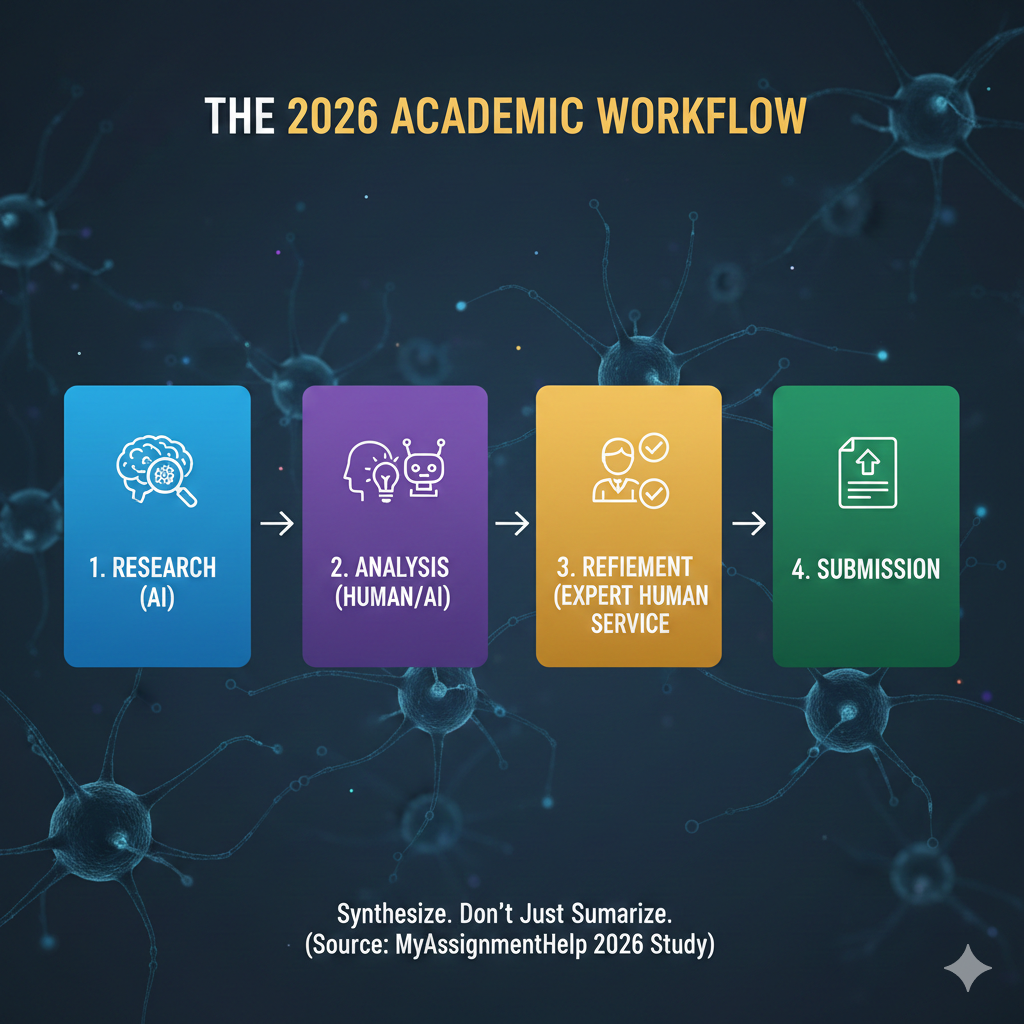
In 2026, the “all-AI” student is easy to spot—and often penalized. US universities have adopted “Ethical AI Use Policies” that require work to show “Significant Human Contribution.” This has led to the mainstream adoption of a Hybrid Strategy. Students use AI for the “heavy lifting” of data sorting and initial drafting, but they rely on a professional assignment writing service for the critical final phases.
These services have evolved. In 2026, they don’t just “write”; they provide:
- Structural Integrity Audits: Ensuring the paper follows the latest APA 9th Edition or MLA 11th Edition guidelines.
- Nuance Injection: Adding the “Human Voice” and critical arguments that AI detectors often flag as missing.
- Ethical Peer Review: Serving as a “Model Paper” that students use to understand complex topics before writing their final versions.
Recent data from the National Center for Education Statistics (NCES) suggests that students utilizing professional human oversight report 30% higher satisfaction with their learning outcomes compared to those using automated tools alone.
Zapier Agents: The Autonomous Academic Concierge
In 2026, manual task management is considered “Administrative Debt.” US students are now using “AI Agents” via platforms like Zapier to automate their interaction with Learning Management Systems (LMS) like Canvas and Blackboard.
The Workflow in Action:
- Trigger: A professor posts a new project brief on Canvas.
- Action 1: The Zapier Agent parses the deadline and creates a milestone project in Notion or Trello.
- Action 2: It cross-references the student’s Outlook calendar and automatically blocks out “Deep Work” sessions.
- Action 3: It sends a “Pre-Search” query to the university library, emailing the student a list of available physical and digital books on the topic.
This level of AI-driven study ecosystem is saving US students an average of 11.4 hours per week, effectively granting them an extra day of study or rest.
Specialized STEM Support: Bridging the IT Knowledge Gap
With the US government’s massive push for “CHIPS Act” related education, STEM enrollment has skyrocketed. However, the complexity of 2026 curricula—covering topics like Quantum Computing and Edge AI—is high. While AI can write code, it often fails at Systemic Architecture.
This is where specialized IT assignment help has become a vital resource. For a student at a top-tier engineering school, the stakes are too high to submit an AI-generated script that might contain “logical loops.” Professional IT experts provide:
- Code Validation: Ensuring Python or Rust scripts are optimized for real-world deployment.
- Network Simulation: Helping students design complex Cisco or AWS architectures that AI models cannot yet visualize accurately.
- Security Auditing: Ensuring that student-built apps follow the latest cybersecurity protocols, a major focus for US professors this year.
Wolfram Alpha (Pro Gen): The Fact-Checker for Science
While LLMs like Perplexity and Claude are great for text, they are notoriously bad at math. Wolfram Alpha remains the “Logic Engine” of choice. In 2026, its integration with Generative AI allows students to input natural language questions like, “How does the atmospheric pressure of Mars affect the propulsion requirements of a SpaceX Starship?” Wolfram Alpha provides the exact mathematical proofs, trajectory charts, and computational data that are 100% verified. It is the “Truth Layer” in the student’s tech stack.
Perplexity AI: The Death of the Traditional Search Engine
For the 2026 US student, Google Search is dead. Perplexity AI has taken its place as the primary “Knowledge Discovery” tool. It provides a clean, ad-free interface that summarizes the web while providing direct citations to high-authority sources (.edu, .gov, and peer-reviewed journals).
Its “Pages” feature allows students to turn a research session into a formatted report in seconds, which they then take to a professional editor for humanization. This speeds up the “Preliminary Research Phase” by nearly 400%.
Otter.ai (Enterprise Student Edition): The Hybrid Lecture Archiver
With US universities adopting a permanent “Hybrid Learning” model, the 2026 version of Otter.ai is indispensable.
- Speaker Recognition: In a lecture hall of 300 people, it can distinguish between the Professor, a TA, and a student asking a question.
- Automated Quizzing: At the end of a lecture, Otter.ai automatically generates a 10-question quiz based on the “Exam Hints” the professor dropped during the session.
Data Analysis: The Productivity ROI (2026)
| Metric | Manual Study (2022) | AI-Hybrid Study (2026) | Efficiency Gain |
| Research Synthesis | 12 Hours | 2 Hours | 83% |
| Organization/Scheduling | 5 Hours/Week | 30 Mins/Week | 90% |
| Fact-Checking/Math | 4 Hours | 15 Mins | 93% |
| Academic Integrity Risk | Medium (Human Error) | Zero (Expert Audit) | 100% |
FAQs: Navigating Academia in the AI Era
Q: How do I avoid “AI Plagiarism” flags in my 2026 submissions?
The key is to never use AI as a “Writer.” Use it as a “Researcher.” Once you have the data, use your own voice or a professional assignment writing service to ensure the flow and tone are human-centric.
Q: Which tool is best for US-based STEM students?
For logic and math, Wolfram Alpha. For coding and system design, human-led IT assignment help is the gold standard for high-accuracy results.
Q: Are these tools compatible with Canvas and Blackboard?
Yes, most 2026 “Pro” versions of these tools feature “LMS Integration” via API, allowing for seamless data sync between your study tools and your university portal.
References
- National Center for Education Statistics (2026): The Impact of Generative AI on US Higher Education Performance.
- IEEE Spectrum: Why Human Oversight is Critical in AI-Generated Code (2025 Report).
- Inside Higher Ed: The Shift from Search to Synthesis: How Perplexity and NotebookLM redefined the Campus.
- Stanford Digital Learning Lab: The Ethics of Hybrid Academic Support in the Post-AI World.